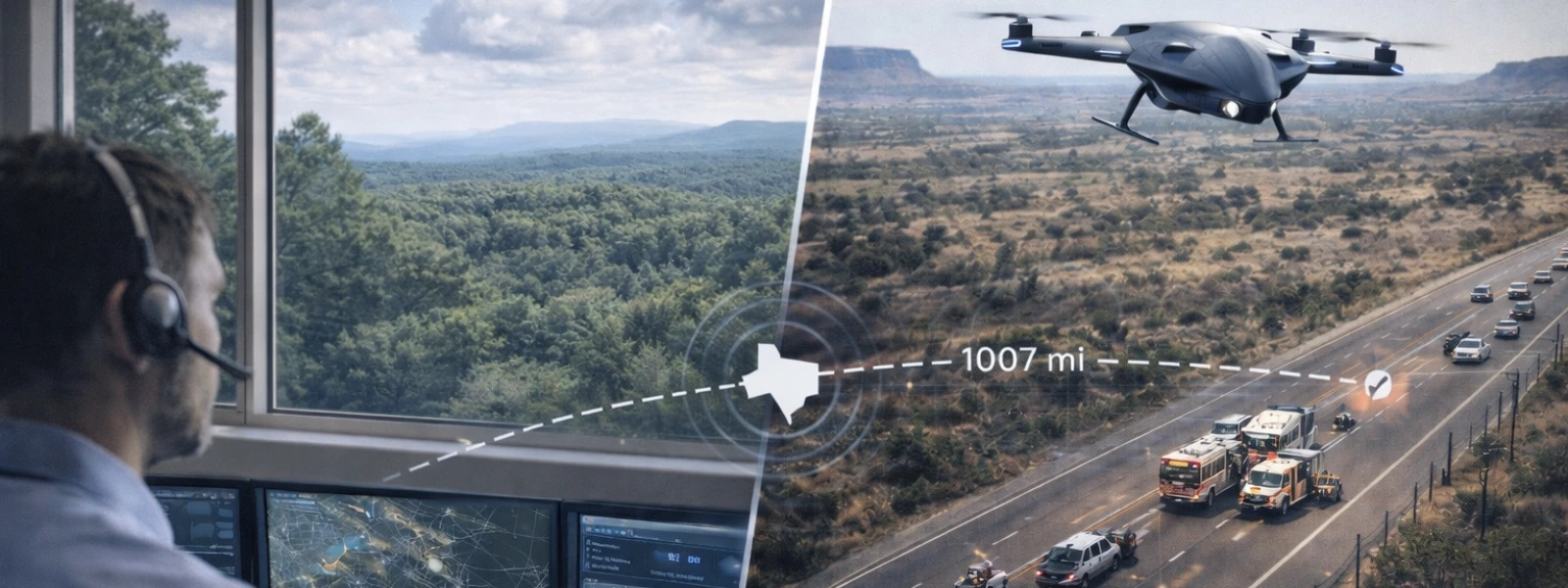
Part 108: The Door to Autonomous Aviation
The FAA's proposed framework would make routine Beyond Visual Line of Sight operations possible for the first time. Here's what you need to know.
Status as of 1 October 2026
Part 108 and Part 146 are proposed rules. The FAA published the NPRM on 7 August 2025 (docket FAA-2025-1908); the final rule is under review, and the FAA has said it hopes to publish by the end of 2026.
Understanding Part 108
A New Chapter in Aviation
Part 108 is the FAA's proposed regulatory framework for routine Beyond Visual Line of Sight (BVLOS) operations of unmanned aircraft. It would represent the most significant expansion of commercial drone operations since Part 107 launched in 2016.
Under Part 107, most commercial drone operations require the pilot to maintain visual contact with the aircraft at all times. This visual line of sight (VLOS) requirement fundamentally limits what drones can do—you can only fly as far as you can see.
Part 108 would change this. For the first time, operators could fly beyond visual line of sight as a matter of routine, through a defined permit or certificate rather than case-by-case waivers.
This isn't just a regulatory update. It would be the FAA's first step toward normalizing autonomous operations in civilian airspace.
Is Part 108 Right for You?
Who Needs Part 108?
Part 108 would matter for operators whose missions require flying beyond what a pilot can see.
Infrastructure Inspection
Power lines, pipelines, rail corridors, and other linear infrastructure that extends beyond visual range.
Delivery Operations
Package delivery, medical supply transport, and logistics operations covering meaningful distances.
Agricultural Operations
Large-scale crop monitoring, precision agriculture, and agricultural spraying across extensive properties.
Public Safety
Search and rescue, emergency response, and law enforcement operations requiring extended range.
Surveying and Mapping
Large-area surveys, photogrammetry projects, and mapping operations impractical under VLOS.
Scalable Drone Operations
Any business model requiring operating at scale—BVLOS is likely essential.
If you're currently operating under Part 107 and finding the VLOS requirement limits your potential, Part 108 is almost certainly relevant to your future.
Requirements
What Part 108 Would Require
Under the proposed rule, operators would hold an operating permit (lower risk) or an operating certificate (higher risk, with a safety management system). Either would demand a demonstrated commitment to safety and operational excellence.
Safety Management System (SMS)
Operators holding an operating certificate (higher risk) would need a formal system for identifying hazards, assessing risks, implementing mitigations, and continuously improving safety.
Personnel Training
The proposed rule creates no individual pilot certificate. The operator would train its Operations Supervisor and Flight Coordinators, with documented proficiency and recurrent training.
Aircraft Acceptance
The manufacturer would file a Declaration of Compliance showing the aircraft meets FAA-accepted consensus standards.
Operational Procedures
Operators would need documented procedures for flight planning, risk assessment, crew coordination, emergency response, and normal operations.
Maintenance Programs
Structured maintenance tracking and documentation would keep each aircraft in the configuration its manufacturer declared.
Airspace Integration
Compliance with airspace requirements, including using Automated Data Service Providers (ADSPs) certificated under proposed Part 146 for services such as strategic deconfliction and conformance monitoring.
Comparison
How Part 108 Differs from Part 107
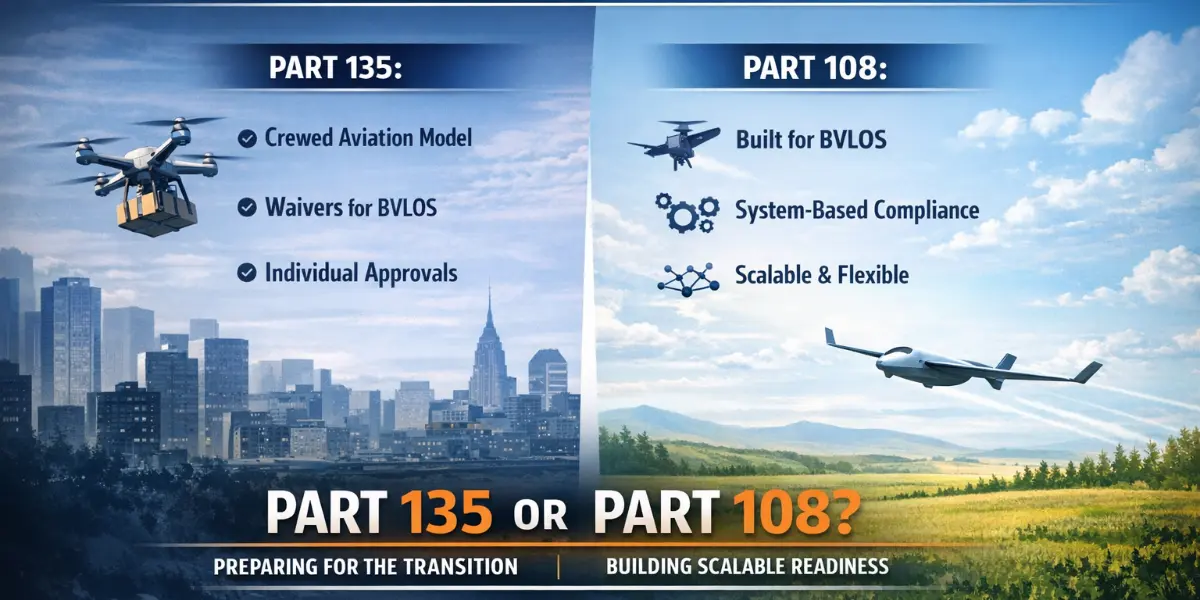
If Part 107 is a driver's license, Part 108 would be closer to an airline operating certificate. The difference isn't just in what you can do—it's in the level of organizational capability required.
| Aspect | Part 107 | Part 108 (proposed) |
|---|---|---|
| Visual requirement | Line of sight required | Beyond visual line of sight would be permitted |
| Authorization | Individual remote pilot certificate | Operating permit (lower risk) or operating certificate (higher risk) |
| Personnel | Certificated remote pilot | Operator-trained Operations Supervisor and Flight Coordinators; no individual certificate |
| Safety management | Not required | SMS required for operating certificates |
| Documentation | Minimal | Comprehensive |
| Ongoing compliance | Limited | Continuing obligations |
| Complexity | Straightforward | Significant |
| Capability | Limited range | Extended operations |

The Future
Part 108 Is Just the Beginning
It's tempting to view Part 108 as the destination. It's not. It would be the first chapter in a much longer story.
The FAA has signaled that autonomous aviation will continue to expand. Part 108 at 400 feet AGL would be the most conservative starting point—proving concepts, building trust, establishing precedent. As the industry demonstrates safety and the technology matures, expect:
- Higher altitude operations
- Operations in more complex environments
- Greater autonomy and reduced human oversight
- Deeper integration with manned aviation
- New operational categories we haven't yet imagined
The operators who build strong foundations now will be positioned to lead as the airspace opens up.