Contents
1. The airspace below 400 feet will not be controlled2. Why existing approaches fail3. Introducing the Distributed Airspace Coordination Layer4. The protocol4.1 Five layers4.2 Message format: intent declaration4.3 Worked example: protocol flow5. The zero-trust model5.1 Trust scoring — how it works5.2 Gaming resistance5.3 Governance: who runs the trust registry?6. A day in the life — scenario walkthrough7. From coordination to threat detection8. Defense applications9. Simulation and validation10. Implementation roadmap11. Why Virabelo1. The Airspace Below 400 Feet Will Not Be Controlled
It will be negotiated.
This is not a prediction. It is an arithmetic inevitability. And it is happening now.
The global race is already underway
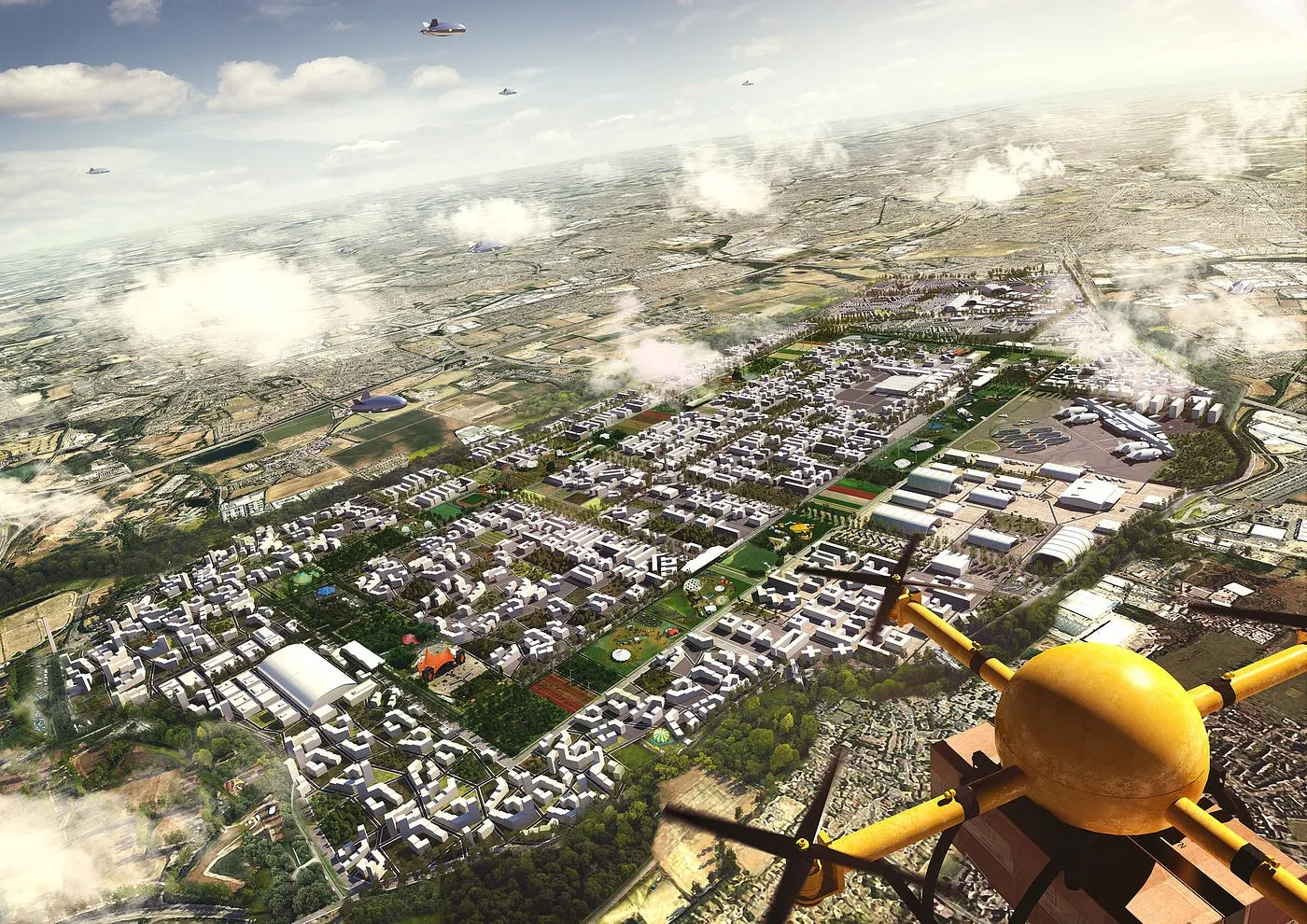
China is aggressively building the infrastructure for its low-altitude economy — regulatory frameworks, urban air mobility corridors, and massive drone delivery networks are being deployed at national scale. The UAE plans operational urban air mobility by the end of 2026. In the United States, Amazon and Wing are preparing to launch drone delivery at commercial scale. The FAA’s Part 108 NPRM establishes the regulatory framework that will unlock thousands of new commercial BVLOS operators — from enterprise fleet operators to individual Part 107 pilots expanding into autonomous operations.
We are about to move from dozens of aircraft to thousands — without changing the coordination model.
Today, a busy day in the low-altitude airspace might involve a handful of drones, widely separated, under individual Part 107 waivers. Within five years, the same airspace may host hundreds of autonomous platforms from dozens of operators — commercial, government, and military — operating simultaneously in proximity to each other, to manned general aviation, and to the public on the ground.
The security dimension is urgent
This is not purely a commercial coordination problem. The use of small UAS in conflicts overseas — from Ukraine to the Middle East — has demonstrated that drones are now weapons of asymmetric warfare. Recent incursions over U.S. military installations have made the domestic threat tangible. As commercial drone density increases, the ability to distinguish a legitimate delivery drone from a surveillance platform or a weaponized UAS becomes exponentially harder.
This will only get more complicated. The window to establish a framework that lets good actors operate efficiently while identifying bad actors quickly is now — before the airspace becomes so congested that retroactive coordination is impossible.
Centralized control cannot scale
Air traffic control cannot manage this. The ATC system was designed for manned aviation: hundreds of flights per sector, each operated by a human pilot in voice communication with a human controller. That model works at flight levels and in controlled airspace because traffic density is manageable and communication bandwidth exists. It does not scale to the low-altitude economy. The traffic density is too high, the platforms are too numerous, the decisions are too fast, and the platforms are too diverse (from 250g inspection drones to 50kg cargo aircraft) for any centralized authority to manage.
And yet the safety problem is real. Autonomous platforms that cannot see each other, cannot communicate their intentions, and have no mechanism for coordinating their movements will converge on the same airspace at the same time.
There is a third option: a protocol that lets autonomous platforms coordinate with each other, directly, without centralized control — and that identifies the platforms that refuse to cooperate. This paper describes that protocol.
2. Why Existing Approaches Fail
Several systems exist or are being developed for low-altitude airspace management. None of them are sufficient for the scale, speed, and security requirements of the autonomous low-altitude economy.
UTM / USS: the right idea, incomplete execution
The FAA’s UAS Traffic Management (UTM) concept and the UAS Service Supplier (USS) ecosystem represent important progress. UTM establishes the principle that drone operators should share flight intent and that third-party service providers can facilitate deconfliction.
However, UTM as currently conceived has fundamental limitations for the autonomous future:
No real-time conformance enforcement
UTM facilitates strategic deconfliction — flight intent sharing before takeoff. But it has no standardized mechanism for real-time verification that platforms are actually following their declared plans.
No trust model
UTM treats all participants equally. An operator with a perfect compliance history receives the same treatment as a first-time operator or an operator with a pattern of violations.
No non-cooperative handling
UTM is a cooperative system — it only works for platforms that participate. It has no mechanism for detecting, classifying, or responding to platforms that are not participating.
Centralized architecture
UTM routes all data through USS providers and the FAA’s FIMS. This creates single points of failure, introduces latency, and creates a governance problem: which USS has authority when two operators with different USS providers conflict?
Remote ID: identification without context
FAA Remote ID provides a mechanism for identifying UAS in flight — similar to a license plate. This is valuable for accountability and law enforcement. But Remote ID provides identification without context. Knowing that a drone is registered to Operator X does not tell you where it plans to go, whether it is following its plan, whether Operator X has a history of safe operations, or whether this particular flight is legitimate.
C-UAS systems: detection without classification
Counter-UAS systems use RF detection, radar, electro-optical sensors, and acoustic sensors to detect drones. These work well against isolated targets in uncongested airspace. They fail in congested environments because they cannot distinguish legitimate commercial drones from threats. When the airspace contains 200 legitimate delivery drones and one hostile platform, a detection-only C-UAS system generates 200 alerts — making the 201st alert operationally useless.
The missing layer across all three systems is the same: a behavioral coordination protocol that generates the data needed for both safety and security.
3. Introducing the Distributed Airspace Coordination Layer
This paper proposes a new class of infrastructure: the Distributed Airspace Coordination Layer (DACL) — a decentralized protocol for autonomous airspace planning, real-time safety verification, and threat identification.
The DACL is not a replacement for UTM, Remote ID, or C-UAS systems. It is the missing layer between them — the layer that adds behavioral context, real-time conformance, and trust-based classification to the identification and intent data that existing systems provide. It is complementary to and built on top of the existing regulatory framework.
Design principles
Planning solves, real-time verifies
95%+ of deconfliction happens pre-mission. Real-time systems confirm the plan is holding. In-flight intervention is the rare exception.
Decentralized by design
No central authority. Each operator runs their own planning intelligence. The protocol defines communication, not command. Consistent outcomes emerge from protocol rules.
Zero trust
No platform is trusted by default. Trust is earned through observed behavior and verified continuously. The same mechanism enables both safety and security.
Three airspace regimes
The DACL supports three operating regimes that scale with traffic density:
Open airspace — peer-to-peer coordination via intent declaration and the shared protocol. No owner, no central authority. Like uncontrolled airspace in manned aviation. Works at low to medium density.
Managed corridors — a single operator declares and manages a defined airspace volume. Sets capacity, rules, entry scheduling. Grants time-gated access to other operators. Like controlled airspace — centralized within the corridor, decentralized between corridors.
Corridor intersections — two corridor owners negotiate using the same protocol at the corridor level. Agreements include altitude separation, time-slicing, or shared merge points. Rare, pre-planned, and mostly static.
Each regime degrades gracefully to the one below on failure.
4. The Protocol
4.1 Five layers
The protocol is a layered stack. Each layer builds on the one below and degrades gracefully to it on failure.
Layer 1 (Detect) requires no cooperation — the platform is observed via ADS-B, Remote ID, or radar. Position and velocity only. Widest uncertainty.
Layer 2 (Identify + Project) infers aircraft type from ADS-B category or Remote ID, selects the appropriate motion model (fixed-wing, helicopter, sUAS), and projects future position as a 3D Gaussian probability distribution. The Collision Probability Engine (CPE) computes P(collision) at five lookahead intervals (0, 30, 60, 90, 120 seconds). No cooperation needed.
Layer 3 (Intent) requires the platform to declare its planned route, timing, altitude, task volumes, and contingency plans. The CPE switches to a plan-aware projection model with dramatically tighter uncertainty: heading σ drops from 90° (unknown sUAS) to 2° (plan-aware), speed σ from 80% to 5%. Conformance monitoring continuously compares declared intent to observed position.
Layer 4 (Negotiate) handles conflicts between declared intents. The planning coordinator detects overlapping volumes or time windows, generates resolution options (time-slice, altitude separation, re-route), and facilitates negotiation between operators. Agreements are binding. Violations degrade trust.
Layer 5 (Manage) provides structured airspace — corridors with capacity limits, slot-based entry scheduling, speed/spacing enforcement, and merge/diverge management.
4.2 Message format: intent declaration
The intent declaration is the foundational message in the DACL. It describes what a platform plans to do, expressed as a sequence of typed segments.
Key design choices: the intent is a sequence of segments (transit routes + task volumes), not just a single flight plan. Each segment carries its own timing, altitude, and contingency plan. The task_volume type declares a bounded 3D volume rather than a route — other platforms know the drone will be somewhere in this cylinder, doing something, for up to 20 minutes. The trust_token is a cryptographically signed credential from the trust registry.
4.3 Worked example: protocol flow
Two operators — Virabelo (inspection) and PrimeAir (delivery) — have drones that will be in the same area at the same time. Here is the actual message exchange:
Pre-mission: T-30 minutes
Conflict detection: T-29 minutes
Negotiation: T-28 minutes
In-flight: T+0 (missions launch)
This entire negotiation happened autonomously between the two operators’ planning coordinators, resolved in seconds, with zero human intervention. Both RPICs see the resolved plan on their supervisor UI. The in-flight conformance monitor verifies both platforms honor the agreement.
5. The Zero-Trust Model
Zero trust is a security posture: no platform is trusted by default. Trust is earned through observed behavior and verified continuously. A platform that declares intent, follows its plan, and participates in the protocol builds trust over time. A platform that fails any of these tests is treated with progressively wider safety margins — or flagged for investigation.
5.1 Trust scoring — how it works
Every platform carries a composite trust score T ∈ [0, 1] that directly controls the CPE’s uncertainty margins. The score is computed from four weighted signals:
Update mechanics
Trust builds slowly and decays fast — the same asymmetry used in credit scoring. Specifically:
Conformance signal uses an exponential moving average (EMA) over the last 100 flights: C_new = α × C_current_flight + (1-α) × C_previous where α = 0.02 (slow build) for positive conformance and α = 0.15 (fast decay) for violations. A single serious violation drops the conformance signal by ~15%. Recovery takes ~50 clean flights.
Protocol signal is binary for each interaction: did the platform file an intent (yes/no), did it respond to a conflict notification (yes/no), did it honor its negotiated agreement (yes/no). Each interaction adds to or subtracts from a running tally.
Credential signal is relatively static — it reflects the platform’s registration and certification status. A fully certified Part 108 operator starts at credential signal = 0.9. An unregistered platform starts at 0.0.
Behavior signal uses statistical anomaly detection: is this platform’s flight pattern consistent with its declared mission type? A delivery drone that follows delivery routes scores 1.0. A platform that loiters near infrastructure without a declared task volume scores lower.
5.2 Gaming resistance
A trust system invites gaming. Three specific attack vectors and their defenses:
Trust farming
Fly 100 compliant flights to build trust, then exploit the high-trust status for a malicious flight.
Defense: Fast decay (α=0.15) means one violation erases ~50 flights of trust building. The cost of farming exceeds the benefit. Additionally, anomalous behavior on a high-trust platform triggers a disproportionate investigation flag — it’s more suspicious when a trusted platform deviates.
Identity spoofing
Claim to be a trusted platform by copying its identifiers.
Defense: The trust_token in the intent declaration is cryptographically signed. Spoofing requires compromising the platform’s private key. Additionally, two platforms claiming the same identity in the same airspace at the same time is immediately detectable.
False intent declaration
Declare a legitimate-looking intent, then deviate from it once airborne.
Defense: Conformance monitoring catches deviation within seconds. Trust immediately begins decaying (fast α). The platform transitions from “trusted” to “non-conforming” to “anomalous” based on the severity and duration of the deviation. The conformance violation is recorded permanently in the trust registry.
Priority gaming
File low-priority intents, then upgrade at the last minute to jump the queue.
Defense: Intent modifications after agreement are treated as new intents and must go through negotiation. Late modifications receive lower priority than established agreements. Repeated last-minute changes degrade the protocol signal component of trust.
The trust spectrum from hostile to fully trusted:
0.0 – 0.2
Hostile / no data. Max uncertainty. Alert.
0.2 – 0.4
Unknown. No protocol. Tracked only.
0.4 – 0.6
Unverified. Participates, not yet proven.
0.6 – 0.85
Verified. Consistent. Standard access.
0.85 – 1.0
Trusted. Tight margins. Priority.
5.3 Governance: who runs the trust registry?
In a decentralized system, who operates the trust registry? Who has authority to set scores? The answer must be consistent with the protocol’s own philosophy: trust no one for long. Constantly reassess.
The trust registry is not a central database with a single operator. It is a federated, append-only log of observed behaviors — conformance records, protocol interactions, agreement violations — contributed by every participating operator. Each operator maintains their own view of the registry and computes trust scores locally using the same published algorithm. Because the inputs are observable events and the algorithm is deterministic, independent operators computing trust for the same platform should arrive at substantially the same score. Divergences are themselves a signal — if Operator A rates Platform X at 0.85 and Operator B rates it at 0.4, the discrepancy indicates that one operator has observed behavior the other hasn’t, which warrants investigation.
No single entity can unilaterally grant or revoke trust. Trust is earned by the platform’s own behavior as observed by the network. The decentralized approach is harder to implement but fundamentally more resilient — and more honest. Trust is what the network observes, not what any authority declares.
6. A Day in the Life — Scenario Walkthrough
Virabelo Drone VB-0847 (utility inspection) files an intent declaration: transit from depot to Substation #14, 20-minute task volume reservation (100m radius, 150-250ft AGL) for Gaussian splatting 3D mesh capture, then transit home. The planning coordinator publishes this to the shared intent registry. Trust score: 0.91 (180 previous flights, 99.4% conformance).
PrimeAir Drone PA-1192 (delivery) files an intent: transit via Corridor C-7, delivery to 14 Oak Street (3-minute task volume), transit home. The corridor sequencer assigns slot 3, entry at 07:12. PA-1192’s transit route crosses VB-0847’s task volume at approximately 07:13. Both operators’ planning coordinators independently detect the conflict. Resolution negotiated in 1.2 seconds: PA-1192 transits at 300ft (above VB-0847’s 250ft ceiling). Zero delay to either mission. Agreement published.
The Flight Agent transitions to task mode. The 3D mapping algorithm takes control of flight behavior within the 100m/150-250ft volume. The Flight Agent enforces the volume boundary and monitors the CPE. The intent registry shows VB-0847 as “in task volume — dynamic within bounds.” All other platforms see this as a reserved cylinder.
PA-1192 is at 302ft, conforming to the agreement. VB-0847 is at 215ft, mapping the substation. Conformance monitor confirms both platforms are honoring the agreement. Separation: 87ft vertical + 60m lateral. CPE: P(collision) = 0.003%. No action required.
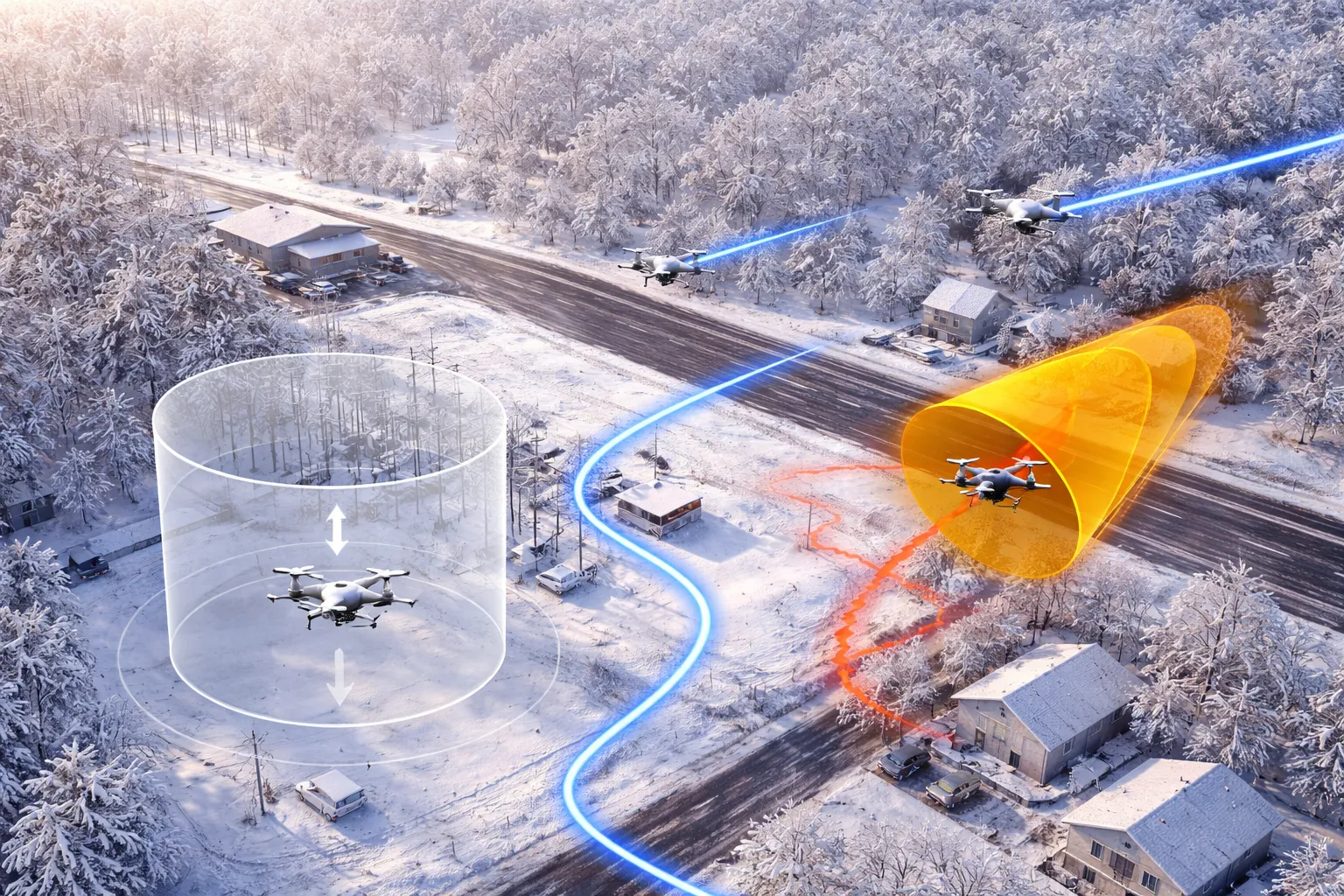
An unknown platform appears on ADS-B at 180ft, 0.8nm southeast of the substation, heading northwest. No intent declaration. No protocol participation. No corridor slot. Trust score: 0.15 (new, no history, no credentials verified).
The system classifies it as non-cooperative — visible. CPE runs with maximum sUAS uncertainty (heading σ=90°, speed σ=80%). At current trajectory, the projected Gaussian overlaps VB-0847’s task volume in approximately 90 seconds. P(collision) rises to 0.4% — Caution level.
VB-0847’s Flight Agent preempts the mapping algorithm: “Emergency — external traffic, hold position.” The drone pauses its mapping orbit and descends to 155ft (bottom of task volume). PA-1192 is unaffected at 302ft. VB-0847’s RPIC receives a notification: “Task paused — unknown traffic at 180ft approaching your volume. Agent holding at 155ft. P(collision) reduced to 0.08%.“
Instead of transiting through, the unknown platform slows and begins circling at 200ft, 200m from the substation. This is behaviorally anomalous — the flight pattern is inconsistent with any transit or delivery profile. The behavior signal drops. Trust score: 0.08. System reclassifies: non-cooperative — anomalous.
The conformance monitor flags the platform for human review. The RPIC and Operations Supervisor both see the alert. If this were near a military installation, the alert would also feed to the installation’s C-UAS system — with the critical context that 200 other platforms in the area are confirmed cooperative and can be ignored.
The unknown platform accelerates northwest and exits the area. VB-0847’s Flight Agent returns control to the mapping algorithm: “Threat cleared. Resuming task.” The mapping continues from where it paused. PA-1192 completed its delivery and is returning via corridor C-7. Total mission delay for VB-0847: approximately 2.5 minutes. PA-1192: zero delay.
The encounter is logged with full telemetry, CPE history, and trust score progression. The unknown platform’s behavioral profile (loitering near infrastructure, no protocol participation) is added to the trust registry. If this platform is seen again, its baseline trust starts lower. If it appears near infrastructure a third time, the escalation threshold drops — it will be flagged for investigation faster.
7. From Coordination to Threat Detection
The scenario above illustrates the core insight: every safety mechanism in the DACL produces security data as a byproduct. No additional detection system was required to identify the anomalous platform. The coordination protocol itself surfaced the threat.
Threat classification framework
Good citizens (T > 0.6)
Protocol participant. Declares intent. Follows plan. Tight margins, priority access. The vast majority of commercial operators.
Poor operators (T 0.3–0.6)
Participates but frequently deviates. Equipment issues or careless ops. Wider margins imposed. Compliance review flagged. Possibly incompetent, not necessarily malicious.
Uncooperative (T 0.1–0.3)
Detectable via ADS-B/Remote ID but no protocol participation. GA aircraft, hobbyist, non-participating operator. Maximum uncertainty. Tracked but unpredictable.
Potential threat (T < 0.1)
Visible, exhibits anomalous behavior: loitering near infrastructure, spoofed IDs, coordinated convergence with other unknowns. Triggers investigation. Escalates to defense systems.
8. Defense Applications
8.1 Counter-UAS target set reduction
The fundamental problem with C-UAS in congested airspace is false positives. Current systems detect everything and classify nothing. When the airspace contains 200 legitimate drones, a detection-only system generates 200 alerts per scan cycle. Operators cannot process this volume; the system becomes operationally useless.
The DACL reduces the target set to the platforms that matter. Every cooperative, conforming platform in the system is verified in real time — its identity, its intent, and its adherence to that intent. These platforms can be filtered from the C-UAS target set automatically. What remains is the small set of non-cooperative or anomalous platforms.
In the scenario above, two of three platforms were immediately classifiable as non-threats through protocol data alone. At scale, with 200 cooperative platforms and 3 unknowns, the reduction is 98.5%.
8.2 Coordinated attack detection
A coordinated drone swarm attack — multiple platforms converging on a target simultaneously — is statistically anomalous against the background of cooperative traffic. The attacking drones either participate in the protocol (revealing coordinated intent that doesn’t match legitimate mission patterns) or they don’t (creating a cluster of non-cooperative platforms converging on a single point). In both cases, the DACL surfaces the anomaly automatically because the cooperative traffic around it provides the behavioral baseline.
8.3 Installation domain awareness
The trust registry becomes an intelligence product. It aggregates behavioral history across time and geography. An operator with consistently low trust scores across multiple installations may warrant investigation even if no single event is conclusive. The DACL provides not just real-time alerting but longitudinal behavioral profiles — the kind of pattern analysis that is impossible with point-in-time detection systems.
9. Simulation and Validation
All protocol rules, trust scoring parameters, and threat detection thresholds are validated through an open-source, lightweight, faster-than-real-time airspace simulator. The simulator models drone positions, intents, and protocol interactions without physics — a “drone” is position, velocity, intent, trust. Run 10,000 simulated operations days overnight on a single machine.
The scoring engine evaluates outcomes across six dimensions: safety, efficiency, fairness, throughput, resilience, and protocol health. Adversarial agents test the protocol’s security properties: false intent, systematic deviation, identity spoofing, trust farming, priority gaming, and coordinated attack patterns.
The simulator publishes data in the same WebSocket format as the production platform. The same supervisor UI that manages live drone operations renders simulated operations — enabling demonstration at scale, operator onboarding sandboxes, and RPIC fleet management training.
The simulator and scoring engine will be published as open-source tools. Other platform operators can test their planning agents against standard scenarios to prove interoperability and conformance.
Detailed simulation results, parameter sensitivity analysis, and validated thresholds will be added as experimental data becomes available.
10. Implementation Roadmap
Protocol primitives
Intent declaration format, conflict detection, basic negotiation. Two simulated operators, crossing conflicts. Publish draft spec.
Corridors + trust
Corridor management, slot scheduling, trust scoring, conformance monitoring. Adversarial agent testing begins.
Threat detection
Non-cooperative classification, anomalous behavior detection, escalation ladder. Validate detection rates and false positive rates.
Scale + interop
50+ operators, hundreds of drones, mixed traffic. Live simulation with partners. Publish conformance suite and open-source simulator.
11. Why Virabelo
The Distributed Airspace Coordination Layer requires a builder that sits at the intersection of commercial drone operations and defense airspace awareness. That intersection is small. Virabelo occupies it.
The core components exist today and are production-proven. Virabelo’s Collision Probability Engine — the physics-based, continuous P(collision) computation that underpins the DACL’s real-time safety verification — is operational software, not a design document. It runs identical math for training simulations and live operations, with aircraft-type-specific motion models, plan-aware projections, source trustworthiness scaling, and four-tier graduated alerting. The Airspace Service fuses ADS-B, weather, NOTAMs, and geospatial data into a unified operational picture. These are not planned features. They are running code.
The training pipeline creates a data moat. Every pilot who trains on Virabelo’s PX4 SITL simulator generates scored telemetry — labeled state-action pairs that train the Flight Agent’s autonomous emergency behavior. This creates platform-specific autonomy models grounded in real human decisions, not theoretical control algorithms. The data compounds: more pilots → better agents → more operators → more data.
The regulatory knowledge is deep. Twenty years of unmanned systems experience across defense and commercial domains. Deep expertise in Part 107, Part 108, Part 146 (ADSP), and Part 89 (Remote ID). The protocol is designed to work within the regulatory framework, not around it — complementing UTM, leveraging Remote ID, and producing the compliance documentation that Part 108 requires.
Virabelo is not proposing to build a product. Virabelo is proposing to define the coordination layer that the low-altitude economy requires — and to build the reference implementation, the simulation testbed, and the conformance suite that prove it works. The DACL is infrastructure. Virabelo is building it because no one else is positioned to build it, and because waiting for a standard to emerge by committee will take years the industry does not have.
The protocol specification and the simulator will be published as open standards and open-source tools. The goal is not to own the coordination layer but to define it — and to be the company whose platform, whose trust registry, and whose simulation environment become the foundation that the industry builds on.
Virabelo is writing the rules of negotiation.
Virabelo, Inc. · Zero-Trust Distributed Airspace Coordination · March 2026