Part 135 vs. Part 108: What Operators Need to Know as the BVLOS Era Approaches
Over the past several weeks, we’ve been having fascinating conversations with advanced drone operators—especially those already flying under Part 135 approvals. A common refrain keeps surfacing:
“Part 135 works for us today. We’re watching Part 108 closely, but we’re not sure when—or if—it makes sense to switch.”
Honestly? That’s a pretty reasonable position. Part 135 has enabled real commercial drone operations at scale, and if you’ve done the hard work to get there, you’re not exactly eager to tear it all down. But Part 108 represents a fundamentally different regulatory philosophy, and understanding those differences now will help you avoid costly rework later.
Let’s dig in.
Why Part 135 Actually Works (For Now)
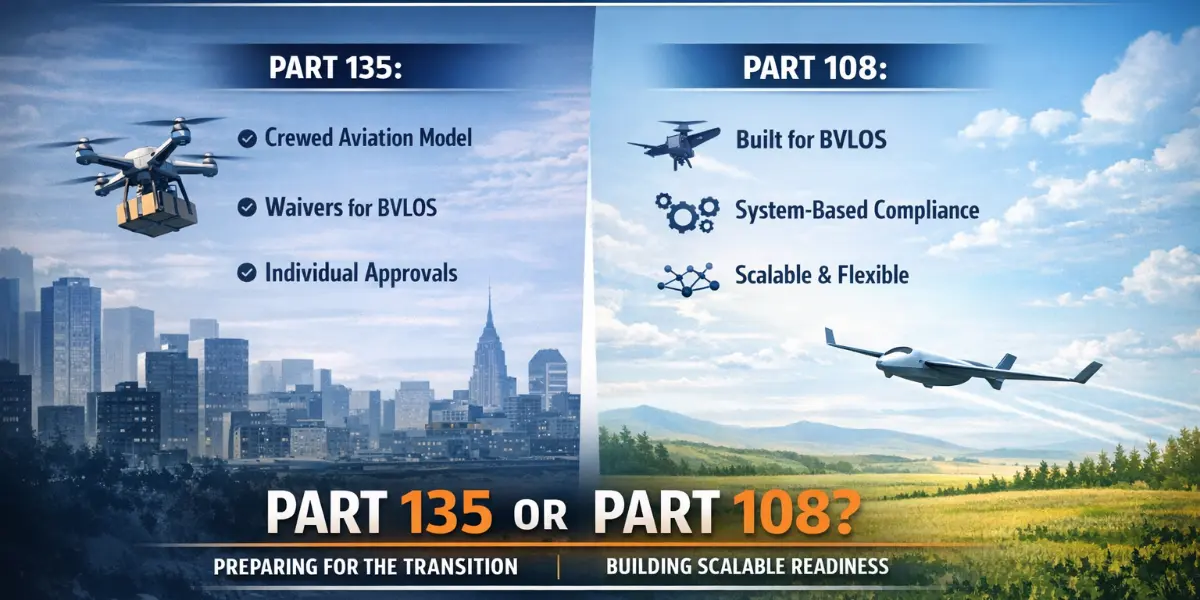
Here’s the thing about Part 135: it was never designed for unmanned aircraft. Not even close. It was built for crewed aviation—think charter flights and air taxis. But clever operators have adapted it successfully because, well, they needed something to fly BVLOS at scale before a dedicated UAS framework existed.
And honestly, it’s worked better than anyone expected.
Part 135 gives you a certifiable path that regulators understand. When you show up with a Part 135 certificate, the FAA knows what they’re looking at. Insurance underwriters aren’t scratching their heads. Enterprise customers aren’t asking their legal teams to decode some experimental approval. There’s comfort in tradition, and Part 135 has decades of tradition behind it.
For operators doing delivery, medical logistics, and time-critical transport, this framework has unlocked routine BVLOS flights, repetitive routes, and actual paid commercial service at scale. That’s not nothing—that’s the whole ballgame for early market entrants who needed to prove the model before anyone else.
The Catch (Because There’s Always a Catch)
Those same operators we’ve been talking to? They’ll also tell you about the tradeoffs—usually with a heavy sigh.
Part 135 is heavy by design. It assumes you have pilots in cockpits, significant operational overhead, and the kind of fixed costs that make sense when you’re flying humans around in metal tubes. For a small number of high-value routes, that math works out fine. But the moment you start diversifying operations, adding aircraft types, or expanding to new mission profiles, things get… crunchy.
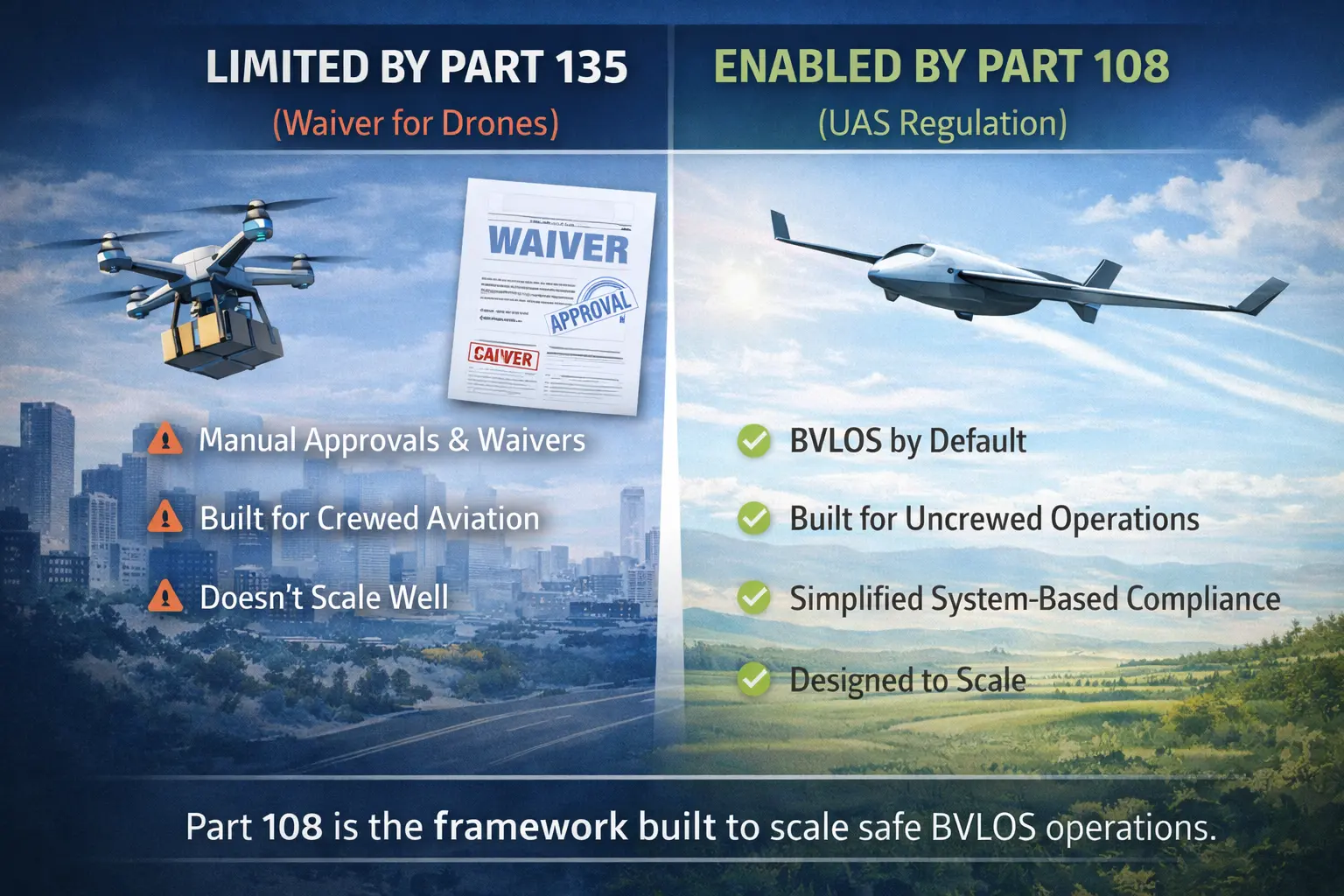
Want to add a new drone model to your fleet? Manual updates. New route? Approvals. Different mission type? Procedural rework. Each expansion feels like you’re pushing a boulder uphill, and that friction has real costs—not just in dollars, but in speed and innovation.
The FAA has always been clear that Part 135 was a bridge, not a destination. It got us here, and we should be grateful. But the destination they’ve been building? That’s Part 108.
Part 108: Not Just “Part 135 for Drones”
Let’s be crystal clear about something: Part 108 is not a reskinned version of Part 135 with “drone” find-and-replaced throughout the document. It’s a ground-up rethink of how unmanned aircraft should operate and scale.
The most striking difference is philosophical. Under the proposed Part 108, BVLOS wouldn’t be treated as some exotic exception that requires heroic paperwork to achieve. It would be the baseline assumption. The framework expects remote operations, distributed fleets, and persistent missions. The whole waiver-centric model that operators live under today? Gone.
Instead of approving individual exceptions one painful application at a time, Part 108 focuses on your systems—your training pipelines, your qualification processes, your ongoing compliance and safety assurance. The FAA is essentially saying: “Show us you have a robust system for producing safe operations, and we’ll trust you to operate within it.”
This is designed for growth that today’s frameworks simply can’t accommodate gracefully. More aircraft. More operators. More complex airspace. Mission types that don’t exist yet and don’t fit neatly into anyone’s current delivery model.
So… Can You Keep Flying Part 135 After Part 108 Drops?
Yes. Breathe easy.
Operators already certificated under Part 135 aren’t going to be forced off that framework the moment Part 108 becomes available. Your existing approvals remain valid.
But here’s the nuance worth chewing on: future expansion may align more naturally with Part 108. If you’re adding new routes, new aircraft, or new mission profiles, you might find that a framework actually designed for UAS makes those approvals easier than wrestling with one built for crewed aviation.
There’s also the softer question of expectations. Over time, stakeholders—capital partners, insurance underwriters, enterprise customers—may increasingly view Part 108 as the “default” UAS operating model, especially for anything that isn’t package delivery. Nobody’s going to flip a switch overnight, but gravitational pull is real.
For most operators, the future isn’t an abrupt switch. It’s a gradual transition, and the smart ones are positioning themselves to make that transition smoothly.
How Virabelo Fits Into All of This
We built Virabelo to be framework-agnostic because we knew this day was coming.
If you’re operating under Part 135 today, we help you structure training, qualification, and readiness tracking in ways that don’t fall apart when the rules change. We manage crew and aircraft status across operations, provide simulation-based preparation for complex missions, and create operational clarity that spans engineering, safety, and compliance teams. These needs exist regardless of which regulatory framework you’re operating under.
But here’s where it gets interesting: Part 108 will reward operators who already think in systems. If you’re treating training, compliance, and mission readiness as continuous processes rather than paperwork events, you’re already ahead. If you’re running scenario-based training that maps directly to operational approvals, you’re building muscle memory that transfers. If your platform scales across aircraft, crews, and mission types without manual rework… well, you’re going to look very smart when everyone else is scrambling.
The Bottom Line
You don’t need to abandon Part 135 to prepare for Part 108.
But operators who wait until Part 108 is finalized to rethink their training pipelines, operational readiness, and compliance workflows are going to find themselves playing catch-up while their competitors are already flying.
The most resilient operators are using today’s operations to build tomorrow’s systems. The regulations will change—that’s inevitable. The question is whether you’ll be ready when they do.
If you’re evaluating how Part 108 fits into your roadmap, or just want to compare notes on future-proofing your Part 135 operations, we’re always happy to chat. This stuff is genuinely fascinating, and we think about it constantly.